Car Key Programming in Crowley TX: OBD vs Bench, 2026
· Locksmith Crowley
How car key programming really works in 2026: the immobilizer handshake, OBD-port work, when a job escalates to bench module work, and Crowley TX pricing.
TL;DR
As of July 2026, car key programming around Crowley TX runs roughly $90–$650 depending on which method your vehicle requires — most jobs finish through the diagnostic port in your driveway, while a minority escalate to bench work on the security module itself, which is why quotes come as ranges instead of one number. Locksmith Crowley identifies the path from your VIN before rolling out, so you know up front whether you're looking at a 30-minute port job off FM 731 or a longer module-level visit. Call or text (817) 756-8838. Three things that separate us here: VIN-based diagnosis before we quote, credentialed access to manufacturer security data, and both OBD and bench capability in one van instead of a referral to somebody else.
This guide is deliberately conceptual: it explains why jobs cost and take what they do, not how to bypass anything. For the how-much version by make, start with our Crowley car key replacement cost guide.
What actually happens when a key talks to your car?
Every vehicle built in the last few decades carries an immobilizer: a small security system that decides whether the engine is allowed to run. It is not the door lock, and it is not the remote. It's the gatekeeper between "the starter turned" and "the engine keeps running."
Inside your key — plastic-headed blade key or proximity fob — sits a transponder. It needs no battery for this function; a coil around the ignition lock or a start-button antenna energizes it wirelessly. The immobilizer control unit, which lives in the engine computer, the body control module, or a dedicated box depending on the make, sends the transponder a challenge. The transponder computes an answer using a secret it holds and returns it. If it matches, fuel and spark are authorized.
That exchange is a handshake, not a password comparison. Modern systems use rolling or cryptographic responses so the same value is never sent twice — which is exactly why a copied blade with no chip turns the ignition and goes nowhere. It's also why "programming" is the right word: a new key isn't matched to a lock, it's introduced to a computer that must be convinced to add it to a list of accepted credentials.
Proximity systems add a layer: the fob and the vehicle also negotiate presence, and newer platforms have hardened that step considerably. Our smart key programming page covers what that means when a fob is added.
Why does a locksmith need security data before touching anything?
Manufacturers don't let any tool write a new key into a security module. Almost every platform requires the technician to first prove authority, usually by supplying a vehicle-specific security value — commonly called a PIN, a security code, or on some domestic systems an incode derived from an outcode the vehicle presents.
Those values are tied to the VIN and held by the manufacturer. Retrieving one is an administrative step with a real-world cost and sometimes a real-world wait. On some makes it's near-instant through a licensed data channel; on others it involves a request, identity verification, and a queue. That's a line item on your invoice that has nothing to do with the physical work — it's the price of doing the job through the front door rather than around it.
So when one make costs more than another for what looks like the same task, the answer is often not the key. It's the security data and the time attached to it.
How does a locksmith get legitimate access to manufacturer security data?
Through a vetting framework, not a workaround. In the United States, the National Automotive Service Task Force administers the system that lets independent, credentialed locksmiths and repair shops obtain manufacturer immobilizer and key data. Locksmiths register, are identity-verified and background-checked, and every request is logged against their credential and the specific vehicle.
The National Automotive Service Task Force describes its secure data release framework as the mechanism that makes manufacturer security information available to vetted, credentialed independent technicians rather than franchised dealers alone, with identity verification and transaction logging built into the process. — National Automotive Service Task Force
The practical consequence is that a legitimate locksmith will ask you to prove the vehicle is yours. Registration, title, insurance, matching photo ID. That request isn't bureaucracy for its own sake — it's the same accountability chain that lets us obtain the data at all. Industry bodies such as the Associated Locksmiths of America hold members to comparable identification standards. If someone offers to make you a key for a vehicle you can't document, that should end the conversation.
What is OBD programming, and why does it cover most vehicles?
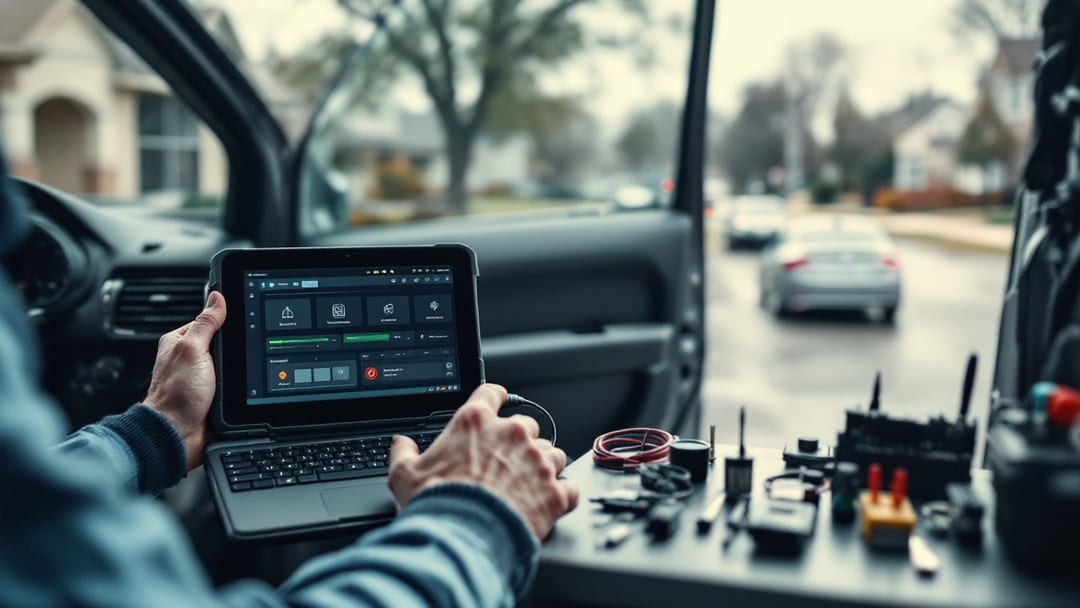
The OBD port is the standardized diagnostic connector under your dashboard. Mandated for emissions diagnostics, it also carries the vehicle's internal communication networks — which is how a programming tool speaks to the immobilizer module without anything being taken apart.
Conceptually the sequence runs like this: the tool identifies the vehicle and its security architecture, authority is established using the manufacturer security value, the module is asked to enter its key-learning state, the new transponder or fob is presented so the module can record it, and the tool confirms acceptance. Then everything gets tested — start, remote, proximity detection, panic, trunk.
Nothing is disassembled. Nothing is soldered. That's why a spare key on a common vehicle is often a 30-minute driveway job in Wynds Ranch, and why key fob programming and transponder key programming sit at the lower end of our range.
When does a key job have to move to the bench?
"Bench work" means the security module comes out of the vehicle and gets worked on directly, on a workbench, with the data read from and written to the memory chip on the board rather than through the diagnostic port. Locksmiths often shorthand this as EEPROM work, after the type of non-volatile memory that historically stored immobilizer data.
A job escalates to the bench for a handful of reasons:
- The platform simply doesn't support all-keys-lost over the port. Some manufacturers deliberately closed that path. If no working key exists, the module has to be addressed directly.
- The module is locked out or corrupted. Battery events, failed prior attempts by someone underqualified, water intrusion, or a bad ground can leave a module that won't respond.
- A module is being replaced. A used or new replacement module usually arrives with the wrong identity and has to be VIN-matched to your vehicle before the car will accept it as legitimate.
- European component protection. Several European platforms bind modules to each other and to the VIN, so key work and module work overlap in ways that domestic vehicles usually avoid.
Bench work costs more because it costs more to do: careful disassembly, delicate electronics handling, soldering in some cases, a data backup before anything is written, reassembly, and a full re-verification of every system that touches the module. The risk profile is higher, the time is longer, and the equipment is expensive. That's the honest reason a bench job carries a bigger number, and it's why BMW all-keys-lost work sits in a different price tier than a domestic sedan.
Why do some vehicles impose a security waiting period?
Because the manufacturer decided a legitimate owner can wait ten, sixteen, or thirty minutes, and a thief usually can't.
Timed security procedures are a deliberate anti-theft design. Before a vehicle will accept a first key with none present, it enters a mandatory lockout during which nothing can proceed. The technician has to be connected, authorized, and patient. Several domestic and Asian platforms use variations of this; the exact duration differs by make and year.
There's nothing to speed up here, and any shop claiming they can skip it is telling you something about their methods. It's on-site time you are paying for, which is why an all-keys-lost quote on a vehicle with a long relearn window looks higher than the parts would suggest. The Hyundai and Kia immobilizer guide covers a family where these procedures come up often.
What does each method cost near Crowley in 2026?
Ranges, not flat quotes. Your number depends on make, model year, key type, and whether any keys are present.
| Job type | Method used | Typical 2026 Crowley range | |---|---|---| | Duplicate transponder key, working key present | OBD port | $90–$220 | | Duplicate proximity fob, working key present | OBD port | $190–$340 | | All keys lost, mainstream domestic or Asian | OBD port + security data | $220–$480 | | All keys lost, timed relearn platform | OBD port + mandatory wait | $260–$520 | | All keys lost, no OBD path available | Bench / module-level | $380–$700 | | Replacement module VIN-matching | Bench / module-level | $350–$650 | | European all-keys-lost with component protection | Mixed OBD and bench | $450–$950 | | Diagnosis only, no key produced | Scan and report | $60–$120 |
If your quote came in higher than expected, the row you're in explains it better than the make does.
What does an escalation look like on a real Crowley job?
A scenario we see a few times a year. A driver near the Crowley Rec Center has an older imported sedan that lost its last working key months ago. The car has been sitting, the battery went completely flat, and a neighbor jumped it repeatedly before anyone called a locksmith.
We arrive expecting an ordinary all-keys-lost job through the port. The scan says otherwise: the immobilizer module isn't answering cleanly and the security data request comes back inconsistent — a common outcome after repeated low-voltage events on that platform. Pushing harder through the port would risk making things worse.
So the job changes shape. With the owner's approval and a revised range, the module comes out, gets read on the bench with a full backup taken first, and is restored and re-matched to the VIN. A new key is written, the module goes back in, and every system that talks to it is verified — start, charging, cluster communication, remote functions. A half-day visit rather than a one-hour one, and the invoice reflects it.
The customer's fair question is always the same: could this have been avoided? Usually yes, back when the car still had one working key. Our spare car key economics guide makes that case with numbers.
FAQ
What's the difference between OBD and bench key programming?
OBD programming talks to your vehicle's security module through the diagnostic port under the dash, with nothing taken apart. Bench programming means removing that module and working on its memory directly on a workbench. OBD covers most jobs; bench work is reserved for platforms or conditions where no port path exists.
Why does a locksmith need my registration and ID before programming a key?
Because manufacturer security data is released only to credentialed technicians who verify vehicle ownership, and every request is logged against that credential. Matching photo ID plus title, registration, or insurance is the standard. A shop that skips this step is one you should be cautious about.
Why did my car need a 10 or 16 minute wait during programming?
Some manufacturers build a mandatory security delay into the process of accepting a first key when none are present. It's an intentional anti-theft measure, it can't be shortened, and it's on-site time you're paying for. Different makes and model years use different durations.
Can every car key be programmed through the OBD port?
No. Most can, but certain platforms never offered an all-keys-lost path through the port, and others lose it when the module is locked out, corrupted, or being replaced. Those jobs move to module-level work, which takes longer and costs more because of the added labor and risk.
Does bench programming damage my car's computer?
Done properly, no. A full data backup is taken before anything is written, the module is handled with appropriate electronics practice, and every affected system is re-verified afterward. The risk comes from underequipped attempts, which is exactly why we diagnose from the VIN before quoting.
Is mobile programming as capable as a dealership?
For key and immobilizer work, a properly equipped mobile locksmith covers the same ground, bench-level jobs included, without the vehicle leaving your driveway. Dealers hold deeper model-specific service access, but key programming is not dealer-exclusive under the vetted-access framework.
Need a key programmed in Crowley today?
Whether it's a straightforward driveway duplicate or a module-level recovery, we diagnose first and quote a range before we roll. Call or text Locksmith Crowley at (817) 756-8838. Text your year, make, model, VIN, and whether you still have a working key, and we'll tell you which method your vehicle needs and what it should cost. Hablamos español — envíanos un texto para una cotización. See our Crowley TX area coverage, our lost car keys service, or reach us through contact.