House Lockout Crowley TX 24/7: What to Expect from a Licensed Mobile Locksmith on the FM 731 Corridor
· Locksmith Crowley
Locked out of your house in Crowley TX? What a licensed mobile locksmith does, 2026 costs, arrival times on the FM 731 corridor, and scams to avoid.
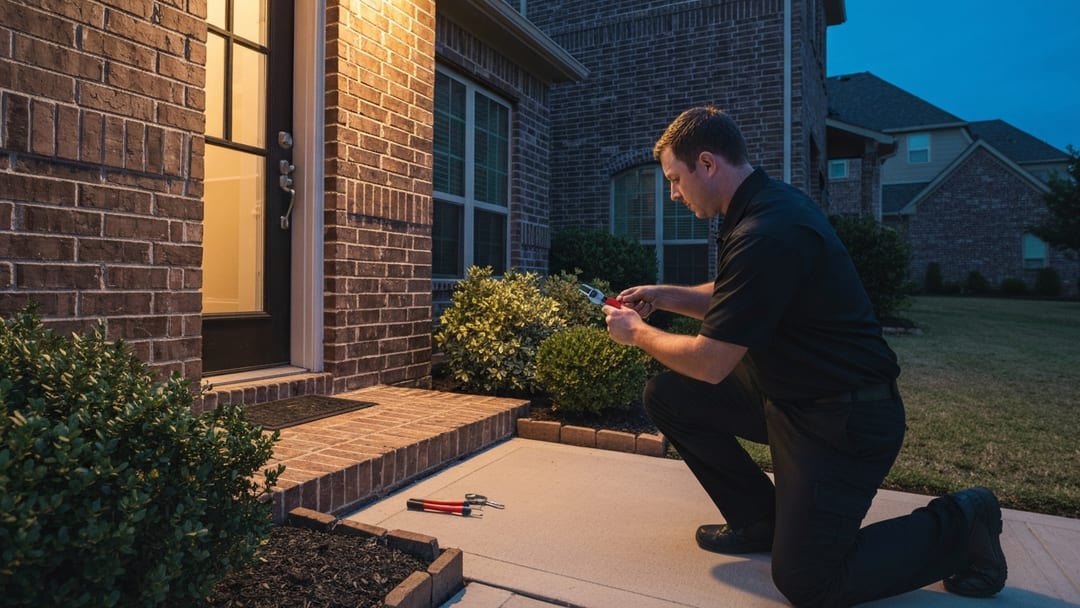
TL;DR
As of May 2026, a standard house lockout in Crowley, TX should cost $75 to $145 for a licensed mobile locksmith during normal hours and $95 to $175 overnight, with an arrival time of 20 to 40 minutes anywhere on the FM 731 corridor between Crowley, Burleson, and Joshua. The job should take 5 to 15 minutes once the technician is on-site, the lock should not be damaged, and you should get a written, fixed-price quote before the technician is dispatched — not a "we'll see when we get there." If anyone tries to drill a standard residential pin-tumbler lock as the first option, or quotes you under $50 to come out and then bills $400+ at the door, you are looking at the FTC-flagged scam pattern that this guide exists to help you avoid. This piece walks through exactly what a real, licensed Crowley locksmith does on a house lockout, the techniques (and limits) of non-destructive entry, what each scenario should cost, and how Crowley's geography along FM 731 and Chisholm Trail Parkway shapes the realistic arrival window.
Per the FTC's locksmith-scams consumer alert, residential lockouts are one of the most heavily targeted consumer categories in the United States for service-industry fraud, precisely because the customer is stressed, often alone, sometimes outside in bad weather, and rarely in a position to comparison-shop. The defenses are simple and worth knowing before you ever need them.
What "locked out of the house" actually means (it changes the price)
Not every house lockout is the same problem. The fix and the cost depend on which of these you're actually facing:
1. Keys locked inside the house, doors locked behind you. The most common case. The lock itself is fine; you just need someone to get the door open without damage. Picking, bumping, or carded entry (if the latch isn't dead-bolted). Usually 5–10 minutes on-site.
2. Keys lost, no spare. The lock is fine but now you need new keys cut and possibly a rekey for security reasons. Entry first (same as above), then the rekey or new-key-cut as a separate scope.
3. Lock is jammed or broken; you have the key but can't turn it. A different problem. Could be a worn lock, a snapped key, a bent bolt, or a misaligned strike plate. May need lock repair or replacement.
4. Smart lock failure. Yale Assure, Schlage Encode, August, Wyze, or similar. Could be a dead battery, a wiped pairing, a failed motor, or a Bluetooth/Z-Wave hub issue. Mostly diagnostic.
5. Locked out + rekey needed for safety reasons. Recent divorce, lost keys with the address tag attached, suspected stolen keys, recently moved in, contractor or housekeeper turnover. Entry first, then a full rekey as a separate but priority scope.
A real licensed locksmith asks you which of these five it is before quoting. A fake one quotes $19 to come out, says "yes" to whatever you describe, and figures out the upcharge at the door.
Non-destructive entry: what actually happens at the door
A good residential lockout almost never involves drilling. Per Associated Locksmiths of America (ALOA) standards, drilling a lock is the last resort, not the first move, and any technician who pulls out a drill within the first 60 seconds of arriving should be politely asked to stop and explain why a non-destructive method won't work.
Here are the techniques a real Crowley residential locksmith uses, in roughly the order they're attempted:
1. Carded latch entry (if the door isn't deadbolted)
If only the doorknob is locked and the deadbolt is not engaged, a thin plastic shim or stiff card can sometimes work the spring-loaded latch back into the door. This is exactly what people try with a credit card on TV. It only works on doors without a deadbolt, with a relatively old or worn latch, and where the door fits the frame loosely. It almost never works on a properly weather-stripped Crowley new-build, but it's the first thing a tech might try because it's fast and free.
2. Lock picking (the standard non-destructive method)
A standard residential pin-tumbler lock — the Kwikset, Schlage, Defiant, Master Lock, etc. that's on 99% of Crowley front doors — can be picked by a trained technician in seconds to a few minutes. Picking moves each pin to its shear line individually using a tension wrench and a pick. It does no damage to the lock and the lock continues working with the original key afterward. This is the default non-destructive technique.
3. Bumping
A bump key is a specially cut key inserted into the lock and tapped sharply while light tension is applied; the kinetic energy momentarily aligns the pins at the shear line. Bumping is faster than picking on standard residential locks but is noisier and may not be appropriate for late-night work in residential areas. Most pros use picking by default and bumping as a backup.
4. Manipulation of specific locks
Some specific residential lock designs respond to specific tools — a Kwikset SmartKey, for example, has its own technique that's different from a standard pin-tumbler. A real locksmith carries the tools and knows the technique.
5. Auxiliary methods for specific door types
- Sliding glass doors with foot-operated latches may need a wedge and a long-reach tool.
- Old-style mortise locks may need different picks.
- Door knobs with anti-pick driver pins (Medeco, Mul-T-Lock, ASSA Abloy) take longer.
6. Drilling — only when nothing else works
Drilling destroys the lock and means you'll be replacing it (a Kwikset Smart Series replacement is typically $40–$80 in parts plus install). Drilling is reasonable when the lock is already broken, the keyway is filled with foreign material, the lock is a high-security model that resists picking, or the customer specifically requests the fastest possible entry and accepts the replacement cost.
Drilling should be discussed and quoted before it happens. Not announced after the bit is in the cylinder.
What it should cost in Crowley (2026 pricing)
These ranges are for Crowley city limits (ZIP 76036) and adjacent areas reachable via FM 731 and Chisholm Trail Parkway. All-in pricing, no zone surcharges, written before dispatch. Get a fixed quote any hour at (817) 756-8838 or via the contact form.
Standard residential lockout
| Time window | Price range | |---|---| | Daytime (7 AM – 9 PM, weekday) | $75–$125 | | Evening (9 PM – 11 PM) | $95–$145 | | Overnight (11 PM – 5 AM) | $115–$175 | | Weekend / holiday daytime | $85–$135 |
These cover the technician's drive, the non-destructive entry, and a clean exit. No lock damage. The price is the same whether the tech needs 5 minutes or 25 minutes at the door — fixed quote, not hourly.
Lockout + new key cut from existing lock
- Lockout + 1 new key cut: $115–$195
If you've lost your keys entirely, the tech can pull the lock cylinder, decode it, and cut a fresh key on the spot. This costs more than a standard lockout because of the additional time and the cut.
Lockout + rekey (recommended after lost keys or move-in)
- Lockout + 4-pin rekey (typical residential deadbolt + knob): $145–$260
Rekeying changes the lock's internal pin combination so any old keys no longer work. This is the right move after a divorce, after a contractor leaves, after losing keys with an identifiable address, or after moving into a previously-occupied house. Rekey takes 10–20 minutes per lock once entry is achieved.
Lockout + full lock replacement (when drilling was necessary or lock is failing)
- Lockout + replace 1 deadbolt with mid-grade Kwikset/Schlage: $145–$235
- Lockout + replace 1 deadbolt with smart lock (Yale Assure / Schlage Encode): $260–$420 plus the smart-lock retail cost
- Lockout + replace 1 knob/lever: $115–$185
The "lock replacement" cost includes the technician's time but typically not the hardware; we carry common Kwikset / Schlage / Defiant inventory on the truck and bill it at standard retail (no markup).
Smart-lock failure diagnostic
- On-site smart-lock diagnostic: $85–$135
- Battery replacement + reset: usually included in diagnostic
- Pairing restoration / firmware reset: usually included
- Motor or component replacement: parts cost on top
Smart locks are increasingly common in Crowley new-builds (especially in the Wynds Ranch, Bonds Ranch, and newer FM 731 corridor developments). The diagnostic time is similar to a standard lockout; the parts are usually inexpensive when needed at all.
How long it actually takes to get there (the FM 731 / Chisholm Trail reality)
Crowley sits at the south edge of the Fort Worth metro. The two arteries that shape mobile-locksmith arrival times here are FM 731 (north-south through the heart of Crowley, connecting to South Hulen St and the I-20 corridor north) and Chisholm Trail Parkway (the toll road running parallel to I-35W, with exits at McPherson Blvd, Sycamore School Rd, and Risinger Rd).
Per typical dispatch patterns, expected arrival windows from our Crowley base of operations:
- Crowley downtown / Main St / Crowley ISD central campus area — 15–25 minutes
- Wynds Ranch (north Crowley) — 15–25 minutes
- Bonds Ranch — 20–30 minutes
- Crowley Town Square / Bicentennial Park — 15–25 minutes
- Crowley Recreation Center / South Crowley Rd — 20–30 minutes
- South Fort Worth along FM 731 (76140) — 20–35 minutes
- Burleson via FM 731 (76028) — 20–35 minutes
- Joshua via FM 731 (76058) — 35–55 minutes
- Cleburne via FM 731 / Old Cleburne Rd (76031) — 45–70 minutes
- Benbrook via Chisholm Trail Parkway (76126) — 25–45 minutes
Severe weather (the occasional Texas ice storm in January), rush hour on Chisholm Trail Parkway northbound during the 5–6 PM window, and Crowley ISD school-zone congestion during morning and afternoon dismissal can each add 10–20 minutes.
If you're locked out and the situation is unsafe — small child or pet inside, exposure to severe weather, after dark in an unfamiliar location, or a known medical-equipment dependency inside — say so on the call at (817) 756-8838. We route the closest technician and don't charge a premium for the priority dispatch. Full service details are on the house lockout service page; if you're locked out of the car instead, see car lockout. Spanish-speaking households: how our bilingual dispatch works end-to-end is covered in the bilingual service guide.
What to do while you're waiting
The 15–40 minute window between calling and the tech arriving is the right time to handle three things:
1. Verify the company's Texas DPS Private Security Bureau license number. Per Texas DPS, residential locksmiths must be licensed in Texas. Ask for the number on the phone, then verify it on the public lookup. A real shop gives you the number without hesitation.
2. Get the price quote in writing. SMS or WhatsApp the dispatcher and ask them to send the quote with year/make/model of lock (if you know it) and the specific scope (lockout only, lockout + rekey, etc.). A written quote is enforceable. A verbal quote at 2 AM is not.
3. Make sure you have ID that matches the property address. Per ALOA standards, a residential locksmith should not open your home without verifying that you have a legal right to be there — typically a driver's license matching the address, a lease with your name, a utility bill, or another form of confirmation if a roommate is present. This protects you from someone using a locksmith to break into your home — and protects the locksmith from legal liability. The verification typically takes under a minute. Be ready for it; if the technician does not ask, that's a sign you may not be dealing with a properly trained operator.
The Crowley scam pattern: what to specifically watch for
Per the FTC's published locksmith-scam alert, the residential-lockout scam runs a predictable script. In Crowley specifically, the pattern usually looks like this:
- You Google "locksmith Crowley" at 11 PM after locking yourself out.
- The top sponsored result is a generic 1-800 number with a stock photo and a vague "Crowley TX Locksmith Service" name.
- The dispatcher quotes "$15 to come out, then we'll see."
- An unmarked white sedan arrives 45 minutes later. The "technician" speaks no Spanish and has no ID, no license number, no business card.
- The technician examines the lock for 30 seconds, claims it has to be drilled ("the lock is too high-security"), drills your perfectly standard Kwikset, then bills $385 plus $90 for the replacement lock plus $40 trip fee, in cash, at the door.
How to defend:
- Never accept a quote substantially under $75 to come out. Real Crowley locksmiths charge enough to cover drive time, equipment depreciation, insurance, and licensing. A $19 quote is bait.
- Never accept "we'll see when we get there." Demand year/make/model-based fixed pricing in writing before dispatch.
- Insist on a marked vehicle or a business card AND a Texas PSB license number at the door.
- Refuse to let a tech drill a standard residential pin-tumbler lock unless they have explained, in writing, why non-destructive entry is not possible on your specific lock.
- Pay with credit card so you have chargeback protection. Cash-only operators have a reason for cash-only.
- Report any pattern that looks like the script above to the FTC and to the Texas DPS Private Security Bureau. The reports drive enforcement.
The through-line of ALOA's residential-entry standards and the FTC's locksmith-scam alert: a licensed, properly equipped technician performs non-destructive entry on the overwhelming majority of standard residential locks without drilling, and quotes a fixed price in writing before dispatch. If you don't see both of those, you're very likely dealing with the scam pattern, not a real locksmith.
What we bring on a Crowley house lockout
Standard equipment on every truck dispatched from our Crowley base:
- Pick sets for every common residential lock format (standard pin-tumbler, Kwikset SmartKey, Schlage Primus, ASSA Abloy, Medeco, Mul-T-Lock)
- Bump-key set with templates for Kwikset, Schlage, Defiant, Weiser, Master Lock
- Long-reach tools for sliding glass doors and high-mount latches
- Key cutting machine (truck-mounted) for cutting replacement keys on-site
- Rekey kits for Kwikset, Schlage, Defiant, Yale, Baldwin
- Replacement deadbolt inventory — mid-grade Kwikset and Schlage in common finishes
- Smart-lock inventory — Yale Assure, Schlage Encode (if requested in advance)
- Diagnostic tools for common smart-lock platforms
- Bilingual technician (English and Spanish) on every dispatch
The truck is marked. The technician carries a Texas DPS PSB pocket card. The receipt is written in the language you booked in (English or Spanish — same flat-rate pricing either way).
When to also consider a full rekey after the lockout
Rekey takes 10–20 minutes per lock once the technician is on-site. Bundled with a lockout, the marginal cost is much lower than calling out a separate service later. Scenarios where it's almost always worth doing right then:
- You lost your keys with anything identifying the address attached (gym bag with both keys and a driver's license, purse with keys plus mail, etc.)
- You're newly moved-in and don't know how many previous owners or contractors had keys
- A roommate has moved out under any circumstances
- A divorce, separation, or restraining order is in process
- A housekeeper or contractor's key was not returned
The cost difference between "lockout only" and "lockout + rekey" is typically $70–$135 — meaningful but not enormous, and it buys real peace of mind. We'll discuss this on the phone before dispatch if you mention any of the above scenarios.
A note on Crowley new-builds and modern lock standards
Newer Crowley developments (especially those built 2018+ in Wynds Ranch and along FM 731) ship with a mix of:
- Builder-grade Kwikset Smart Series deadbolts — adequate but easily picked
- Schlage Encode WiFi smart locks — much better security, more diagnostic complexity
- Yale Assure SL Z-Wave — common in DR Horton and Lennar builds
- August Wi-Fi Smart Lock — common in retrofits
If you live in a newer Crowley home, it's worth knowing which platform you have before an emergency. Take a photo of the inside of your deadbolt — the brand and model are usually printed there — and keep it in your phone. When you call, that two-second photo lets us bring the right tools and parts for first-call resolution rather than a follow-up visit.
FAQ
How long does a Crowley house lockout actually take, start to finish? From the time you call to the time you're inside, typically 25–55 minutes. About 15–40 minutes of that is drive time depending on where in Crowley / Burleson / Joshua you are along the FM 731 corridor, and 5–15 minutes is the actual non-destructive entry. We send an SMS update if traffic on Chisholm Trail Parkway delays the tech.
Will the locksmith damage my lock? On a standard residential pin-tumbler lock (Kwikset, Schlage, Defiant, etc.), almost never. Non-destructive entry — picking or bumping — is the default. Drilling is the last resort and is discussed and quoted before it happens. If anyone pulls out a drill in the first 60 seconds without explanation, ask them to stop.
¿Cuánto cuesta abrir una puerta de casa en Crowley a medianoche? Una emergencia residencial de medianoche en Crowley anda entre $115 y $175 con un cerrajero con licencia. Te damos el precio fijo por teléfono o WhatsApp antes de mandar al técnico — no hay cargos sorpresa en la puerta. Hablamos español y la entrada es sin daño al cerrojo en el 95% de los casos. Si alguien te quiere cobrar $19 por venir y luego $400 en la puerta, eso es la estafa típica que la FTC ha denunciado.
Do I need to provide ID before you'll open my house? Yes. Per ALOA professional standards and basic legal liability, a residential locksmith should verify you have a legal right to be in the home before performing entry. A driver's license matching the address is typical; a recent utility bill, lease, or other bilingual confirmation also works. The check takes under a minute and protects both you and us.
Sources
- FTC consumer alert on locksmith scams — anti-scam consumer guidance
- Associated Locksmiths of America (ALOA) — Registered Locksmith standards for residential entry
- Texas DPS Private Security Bureau — Texas residential locksmith licensing
- National Automotive Service Task Force (NASTF) — security-industry professional standards
- FTC consumer-protection resources — written-quote and language-access guidance